Use radians unless stated otherwise. On calculator questions, keep full precision until the end. For free response, show your work and include units.
0 / 40MCQs checked
0Correct on first try, unaided
0Correct on latest check
Your answers and notes are saved in this browser.
Clear this AP Precalculus practice page’s answers and notes from this browser?
MCQ 01No calculator
Unit 1 · Polynomial & rational
Finite differences
The table gives selected values of f at equally spaced inputs. Which statement best supports a quadratic model for these data?
Selected function values
x
0
1
2
3
f(x)
5
9
15
23
Worked solution
Answer: B
The first differences are 4, 6, and 8. Their differences are 2 and 2. Constant nonzero second differences for equally spaced inputs support a quadratic model.
MCQ 02No calculator
Unit 1 · Polynomial & rational
Polynomial end behavior
Let p(x) = -2(x + 1)2(x - 3)3. Which statement describes its end behavior?
Worked solution
Answer: D
The leading term is -2x5. An odd degree with a negative leading coefficient gives a left end that rises and a right end that falls.
MCQ 03No calculator
Unit 1 · Polynomial & rational
Holes and asymptotes
For r(x) = [(x - 2)(x + 3)] / [(x - 2)(x - 4)], which pair correctly gives a hole and a vertical asymptote?
Worked solution
Answer: A
Cancel x - 2 while retaining the restrictions x ≠ 2, 4. The reduced expression is (x + 3)/(x - 4). At x = 2 its value is -5/2, so the hole is (2, -5/2). The uncanceled denominator gives x = 4 as a vertical asymptote.
MCQ 04No calculator
Unit 1 · Polynomial & rational
Rational end behavior
The function f is given by f(x) = (3x2 - x + 1)/(2x2 + 5). Which line is a horizontal asymptote of its graph?
Worked solution
Answer: C
The numerator and denominator have the same degree. Dividing their leading coefficients gives the horizontal asymptote y = 3/2.
MCQ 05No calculator
Unit 1 · Polynomial & rational
Polynomial inequalities
Let p(x) = (x + 2)(x - 1)2(x - 4). For which x is p(x) > 0?
Worked solution
Answer: A
Away from x = 1, the squared factor is positive, so the sign is the sign of (x + 2)(x - 4). This product is positive outside its two zeros. Strict positivity excludes x = -2 and x = 4; x = 1 is not in either resulting interval.
MCQ 06No calculator
Unit 1 · Polynomial & rational
Function transformations
The point (2, -3) is on the graph of f. Which point must be on the graph of g(x) = -2f(3(x - 1)) + 5?
Worked solution
Answer: D
To use f(2) = -3, set 3(x - 1) = 2. This gives x = 5/3. Then g(5/3) = -2(-3) + 5 = 11.
MCQ 07No calculator
Unit 1 · Polynomial & rational
Average rate of change
For f(x) = -x2 + 6x + 1, what is the average rate of change of f over [1, 4]?
Worked solution
Answer: B
Compute f(1) = 6 and f(4) = 9. The average rate is [f(4) - f(1)]/(4 - 1) = (9 - 6)/3 = 1.
MCQ 08No calculator
Unit 1 · Polynomial & rational
Complex zeros
A monic polynomial with real coefficients has zeros 2 and 1 + 3i. Which polynomial of least possible degree satisfies these conditions?
Worked solution
Answer: C
Real coefficients require the conjugate zero 1 - 3i. Thus p(x) = (x - 2)[(x - 1)2 + 9] = (x - 2)(x2 - 2x + 10), which expands to choice C.
MCQ 09No calculator
Unit 1 · Polynomial & rational
Graphical reasoning
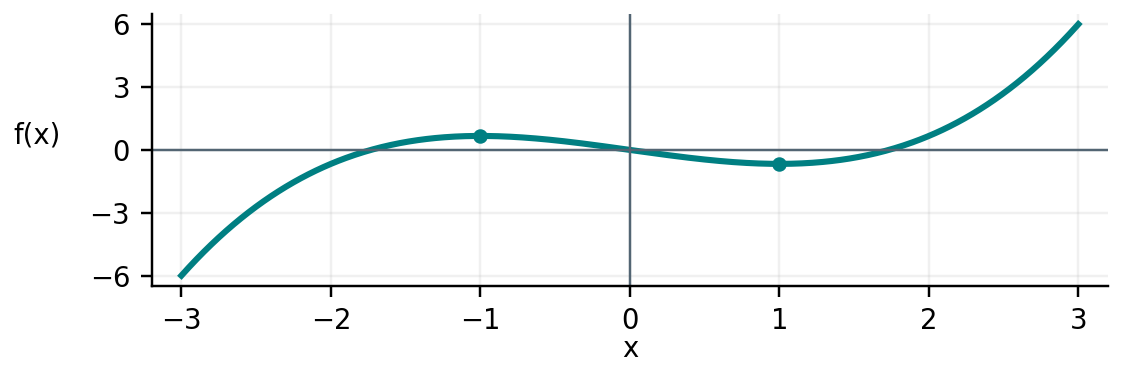
The graph of a polynomial f is shown. On which interval is f both increasing and concave down?
Worked solution
Answer: A
On (-3, -1), the graph rises as x increases, but it becomes less steep as it approaches its local maximum. Its secant slopes decrease, so it is concave down on that interval.
MCQ 10No calculator
Unit 1 · Polynomial & rational
Slant asymptotes
Let r(x) = (x2 + 3x + 5)/(x + 1). Which expression approaches 0 as x → +∞?
A geometric sequence has positive terms, a2 = 12, and a5 = 96. Which formula gives an for n ≥ 1?
Worked solution
Answer: C
The common ratio r satisfies r3 = 96/12 = 8, so r = 2. Therefore an = 12 · 2n-2 = 3 · 2n.
MCQ 12No calculator
Unit 2 · Exponential & logarithmic
Exponential models
An exponential function has the form f(x) = abx, where a > 0 and b > 0. If f(2) = 18 and f(5) = 486, which formula gives f?
Worked solution
Answer: D
Divide the given outputs: b3 = 486/18 = 27, so b = 3. Since a · 32 = 18, a = 2.
MCQ 13No calculator
Unit 2 · Exponential & logarithmic
Exponential transformations
Let h(x) = 5 + 3 · 2-x. Which statement is true?
Worked solution
Answer: B
Because 2-x = (1/2)x, the exponential term decreases and is always positive. Adding 5 gives outputs greater than 5 and a horizontal asymptote y = 5.
MCQ 14No calculator
Unit 2 · Exponential & logarithmic
Logarithmic equations
What is the real solution of log2(x - 1) + log2(x - 3) = 3?
Worked solution
Answer: A
The domain requires x > 3. Combine logarithms to obtain (x - 1)(x - 3) = 8. Then x2 - 4x - 5 = 0, so x = -1 or 5. Only x = 5 is in the original domain.
MCQ 15No calculator
Unit 2 · Exponential & logarithmic
Inverse functions
For f(x) = 4 · 3x-2 + 1, which formula gives f-1(x)?
Worked solution
Answer: C
From y = 4 · 3x-2 + 1, obtain (y - 1)/4 = 3x-2. Taking log base 3 and adding 2 gives x = log3((y - 1)/4) + 2. The inverse domain is x > 1.
MCQ 16No calculator
Unit 2 · Exponential & logarithmic
Function composition
Selected values of f and g are given in the table. What is f(g(1))?
Selected function values
x
-1
0
1
2
3
f(x)
2
3
-1
0
1
g(x)
1
-1
2
3
0
Worked solution
Answer: D
Read the inner function first: g(1) = 2. Then read f(2) = 0. Thus f(g(1)) = 0.
MCQ 17No calculator
Unit 2 · Exponential & logarithmic
Semi-log representations
A plot of log10(y) versus x is a straight line through (0, 1), (2, 2), and (4, 3). Which model represents the original data?
Worked solution
Answer: A
The transformed line has slope 1/2 and intercept 1: log10(y) = 1 + x/2. Exponentiating base 10 gives y = 101+x/2 = 10 · 10x/2.
MCQ 18No calculator
Unit 2 · Exponential & logarithmic
Exponential rates of change
Let f(x) = 8(1.5)x. Which statement correctly compares the average rates of change over [0, 1] and [1, 2]?
Worked solution
Answer: B
The outputs are f(0) = 8, f(1) = 12, and f(2) = 18. For intervals of length 1, the average rates are 12 - 8 = 4 and 18 - 12 = 6. Positive, increasing rates are consistent with this increasing, concave-up exponential function.
MCQ 19No calculator
Unit 2 · Exponential & logarithmic
Logarithmic behavior
Which statement describes k(x) = log1/2(x + 2)?
Worked solution
Answer: C
The logarithm argument must be positive: x + 2 > 0. A logarithm with base between 0 and 1 is decreasing. A horizontal translation preserves that decreasing behavior.
MCQ 20No calculator
Unit 3 · Trigonometric & polar
Radian measure
An arc of length 5π lies on a circle of radius 6. What is the measure in radians of the central angle that subtends the arc?
Worked solution
Answer: D
Use arc length s = rθ. Therefore θ = s/r = 5π/6 radians.
MCQ 21No calculator
Unit 3 · Trigonometric & polar
Trigonometric values
If θ is in quadrant III and sin θ = -3/5, what is tan θ?
Worked solution
Answer: A
The identity sin2θ + cos2θ = 1 gives |cos θ| = 4/5. In quadrant III, cos θ = -4/5. Thus tan θ = (-3/5)/(-4/5) = 3/4.
MCQ 22No calculator
Unit 3 · Trigonometric & polar
Sinusoidal graphs
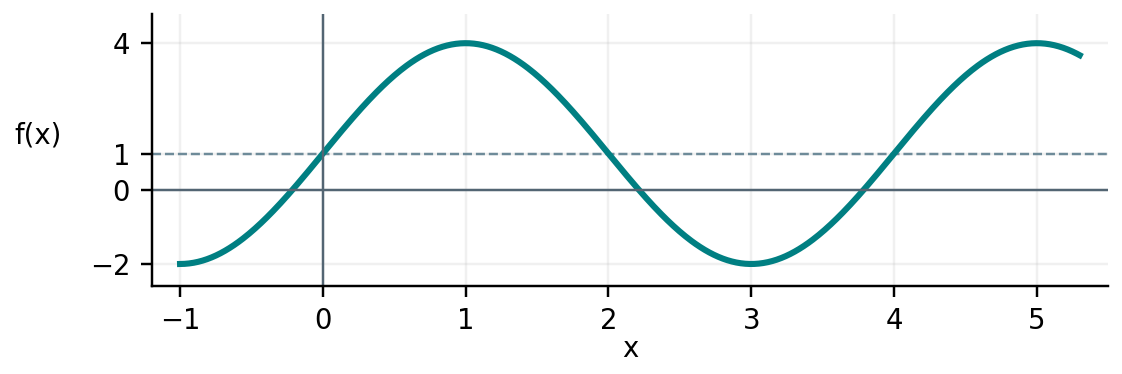
Which function represents the sinusoidal graph shown?
Worked solution
Answer: B
The maximum is 4 and the minimum is -2, so the amplitude is 3 and the midline is y = 1. Consecutive maxima occur at x = 1 and x = 5, giving period 4 and angular coefficient 2π/4 = π/2. The graph crosses the midline upward at x = 0, matching the sine model.
MCQ 23No calculator
Unit 3 · Trigonometric & polar
Trigonometric equations
What are all solutions of 2 sin2x - sin x - 1 = 0 on 0 ≤ x < 2π?
Worked solution
Answer: C
Factor as (2 sin x + 1)(sin x - 1) = 0. Thus sin x = -1/2 or sin x = 1. On the specified interval these give x = 7π/6, 11π/6, and π/2.
MCQ 24No calculator
Unit 3 · Trigonometric & polar
Inverse trigonometric functions
What is the exact value of arcsin(sin(5π/6))?
Worked solution
Answer: D
First, sin(5π/6) = 1/2. The principal range of arcsin is [-π/2, π/2], so arcsin(1/2) = π/6.
MCQ 25No calculator
Unit 3 · Trigonometric & polar
Trigonometric identities
For values of x where the original expression is defined, (1 - cos(2x))/sin(2x) is equivalent to which expression?
Worked solution
Answer: A
Use 1 - cos(2x) = 2 sin2x and sin(2x) = 2 sin x cos x. Their quotient simplifies to sin x/cos x = tan x, on the domain of the original expression.
MCQ 26No calculator
Unit 3 · Trigonometric & polar
Tangent asymptotes
Which set contains all vertical asymptotes of y = tan(2x - π/3)? In each choice, k is any integer.
Worked solution
Answer: B
Tangent is undefined when its argument is π/2 + kπ. Set 2x - π/3 = π/2 + kπ and solve: x = 5π/12 + kπ/2.
MCQ 27No calculator
Unit 3 · Trigonometric & polar
Polar coordinates
Which rectangular coordinates represent the polar point (-4, 2π/3)?
Worked solution
Answer: C
Use x = r cos θ and y = r sin θ. Then x = (-4)(-1/2) = 2 and y = (-4)(√3/2) = -2√3. A negative r places the point opposite the ray at angle 2π/3.
MCQ 28No calculator
Unit 3 · Trigonometric & polar
Polar rates and distance
For the polar curve r = 2 cos θ, θ increases from π/2 to π. Which statement is true over the interior of this interval?
Worked solution
Answer: D
Cosine decreases from 0 to -1, so r decreases from 0 to -2. Distance from the origin is |r|, which increases from 0 to 2. Signed radius and distance have different behavior here.
MCQ 29Calculator required
Unit 1 · Polynomial & rational
Numerical zeros
The equation x3 - 4x - 1 = 0 has exactly one solution in 1 < x < 3. What is that solution, to the nearest thousandth?
Worked solution
Answer: C
Graph y = x3 - 4x - 1 and locate its zero in (1, 3), or use a numerical equation solver. The solution is x = 2.114907541..., which rounds to 2.115.
MCQ 30Calculator required
Unit 1 · Polynomial & rational
Graphing polynomial extrema
Let p(x) = 0.08x3 - 1.2x2 + 4x + 6 on 0 ≤ x ≤ 10. At which x does its graph change from increasing to decreasing?
Worked solution
Answer: B
A graphing calculator shows a local maximum at x = 2.113248654... and a local minimum at x = 7.886751346.... The change from increasing to decreasing occurs at the local maximum, x ≈ 2.113. No differentiation is needed.
MCQ 31Calculator required
Unit 1 · Polynomial & rational
Rational modeling
The total cost of producing n items is 4200 + 18n dollars. What is the least positive integer n for which the average cost per item is less than $30?
Worked solution
Answer: D
Average cost is (4200 + 18n)/n = 4200/n + 18. Since n > 0, the inequality 4200/n + 18 < 30 gives n > 350. Strict inequality makes 351 the least possible integer.
MCQ 32Calculator required
Unit 1 · Polynomial & rational
Quadratic regression
Use quadratic least-squares regression for the data in the table. What value does the model predict at x = 5, to the nearest thousandth?
Selected function values
x
0
1
2
3
4
y
2.1
5.0
10.2
17.1
26.0
Worked solution
Answer: A
Quadratic regression gives y ≈ 0.978571429x2 + 2.075714286x + 2.057142857. Substituting x = 5 using unrounded coefficients gives y = 36.900.
MCQ 33Calculator required
Unit 2 · Exponential & logarithmic
Exponential regression
Fit ln y = α + βx by least-squares regression to the data. Use y = eαeβx to predict y at x = 8. Which value is closest?
Selected function values
x
0
2
4
6
y
120
158
212
278
Worked solution
Answer: B
Regressing ln y on x and exponentiating gives y ≈ 119.8710567(1.151101106)x. At x = 8, the prediction is 369.5065178..., so 369.5 is closest. Fitting the logarithms is explicitly specified to avoid differences between regression methods.
MCQ 34Calculator required
Unit 2 · Exponential & logarithmic
Exponential equations
A culture is modeled by N(t) = 180e0.16t, where t is in hours. When does the model predict N(t) = 500?
A liquid has temperature T(t) = 21 + 74(0.86)t degrees Celsius, with t in minutes. At what time does it first reach 30°C?
Worked solution
Answer: D
Set 21 + 74(0.86)t = 30, so (0.86)t = 9/74. Then t = ln(9/74)/ln(0.86) = 13.968970622... minutes. The function decreases, so this is its only crossing.
MCQ 36Calculator required
Unit 2 · Exponential & logarithmic
Inverting a logarithmic model
A response is modeled by R(x) = 2.7 + 1.8 ln x for x > 0. What x gives R(x) = 7?
Worked solution
Answer: A
Rearrange to ln x = (7 - 2.7)/1.8. Exponentiating gives x = e(7-2.7)/1.8 = 10.901374573....
MCQ 37Calculator required
Unit 3 · Trigonometric & polar
Numerical trigonometric equations
What is the smallest positive solution of 3 sin(0.7x) = 0.4x? Use radians.
Worked solution
Answer: C
Find intersections of y = 3 sin(0.7x) and y = 0.4x in radian mode. Besides x = 0, the first positive intersection is x = 3.741795188.... The zero solution is excluded by the word positive.
MCQ 38Calculator required
Unit 3 · Trigonometric & polar
Sinusoidal inequalities
Let H(t) = 12 + 4.5 cos((π/6)(t - 2)) for 0 ≤ t ≤ 12. For how many total units of time is H(t) > 15?
Worked solution
Answer: B
The inequality becomes cos((π/6)(t - 2)) > 2/3. The interval [0, 12] is one full period. The angular width is 2 arccos(2/3), so the time length is (6/π) · 2 arccos(2/3) = 3.212645674... units.
MCQ 39Calculator required
Unit 3 · Trigonometric & polar
Average radial change
For r(θ) = 3 + 2 sin(2θ), what is the average rate of change of r with respect to θ on 0.4 ≤ θ ≤ 1.1? Use radians.
Worked solution
Answer: D
The average rate is [r(1.1) - r(0.4)]/(1.1 - 0.4) = 2[sin(2.2) - sin(0.8)]/0.7 = 0.260400894... radial units per radian.
MCQ 40Calculator required
Unit 3 · Trigonometric & polar
Periodic context
A rider’s height is h(t) = 18 - 15 cos(πt/20) meters, where t ≥ 0 is in seconds. At what time does the rider first reach 25 meters?
Worked solution
Answer: A
Solve 18 - 15 cos(πt/20) = 25 to obtain cos(πt/20) = -7/15. During the first rising half-cycle, t = (20/π) arccos(-7/15) = 13.090904365... seconds. The later solution is not the first time.
FRQ 01Calculator required
6 practice points · Suggested time: 15 minutes
Function concepts
The table gives selected values of a one-to-one function f. The function g is defined by g(x) = 1.8x - 2 for all real x.
Selected function values
x
0
1
2
3
4
f(x)
1
4
2
5
8
Part A. (i) Find f-1(5). (ii) Find g(f(2)).
Part B. (i) Find the average rate of change of f over [1, 4]. (ii) Use the secant line through (2, f(2)) and (3, f(3)) to estimate f(2.5).
Part C. (i) Find the value of x for which g(x) = f(4). (ii) Write a formula for g-1 and state its domain.
Solving y = 1.8x - 2 for x gives g-1(x) = ln(x + 2)/ln 1.8, with domain x > -2.
1 point: correct inverse formula and domain.
Review focus: A table lookup must follow the order of composition. Inverse inputs are outputs of the original function.
Use the rubric to self-assess. These are practice points, not an official AP score.
FRQ 02Calculator required
6 practice points · Suggested time: 15 minutes
Nonperiodic modeling
A dissolved substance has concentration C(t) milligrams per liter t hours after observation begins. On 0 ≤ t ≤ 24, an exponential model C(t) = abt fits the data below exactly. Assume 0 < b < 1.
Selected function values
t (hours)
0
2
4
C(t) (mg/L)
80
60.8
46.208
Part A. Find a and b. Show the equations used to determine these constants.
Part B. (i) Use the model to predict C(6). (ii) Find the time t when the concentration reaches 12 mg/L.
Part C. (i) State the percent decrease in concentration over every two-hour interval. (ii) A linear model L through the first two data points is proposed instead. Find L(t) and explain why it is unsuitable for the entire interval 0 ≤ t ≤ 24.
Worked solution & 6-point rubric
A
C(0) = a = 80. Also, 60.8 = 80b2, so b2 = 0.76 and b = √0.76 ≈ 0.871780. Thus C(t) = 80(0.76)t/2.
2 points: 1 for a = 80 with a supporting equation; 1 for b = √0.76 with a supporting equation.
B(i)
C(6) = 80(0.76)3 = 35.11808, so the prediction is 35.118 mg/L.
1 point: correct predicted concentration.
B(ii)
Solve 80(0.76)t/2 = 12. Then t = 2 ln(12/80)/ln(0.76) = 13.825548680..., or 13.826 hours.
1 point: correct time.
C(i)
Over two hours, the multiplier is b2 = 0.76. The percent decrease is (1 - 0.76) × 100% = 24%.
1 point: correct percent decrease.
C(ii)
The slope is (60.8 - 80)/2 = -9.6, so L(t) = 80 - 9.6t. For t > 80/9.6 = 25/3 hours, L(t) is negative. Negative concentration is impossible, so this model is unsuitable for all of [0, 24].
1 point: correct linear model and a valid contextual explanation.
Review focus: The two-hour multiplier is 0.76; the one-hour multiplier is √0.76. Retain the exact form when calculating later predictions.
Use the rubric to self-assess. These are practice points, not an official AP score.
FRQ 03No calculator
6 practice points · Suggested time: 15 minutes
Periodic modeling
A wave-testing tank is programmed so that its water depth d(t), in centimeters, varies sinusoidally with time t in minutes. A maximum depth of 11 cm occurs at t = 1, the next minimum of 3 cm occurs at t = 5, and the next maximum occurs at t = 9.
Part A. (i) State the amplitude, midline value, and period. (ii) Write a formula for d(t).
Part B. (i) Find d(3). (ii) Find all exact times t in 1 ≤ t ≤ 9 when the depth is 9 cm.
Part C. (i) Give the interval between t = 1 and t = 9 on which the depth is increasing. (ii) Find the average rate of change of d over [1, 5] and interpret it in context.
A cosine model that starts a cycle at the maximum t = 1 is d(t) = 7 + 4 cos((π/4)(t - 1)). Its period is 2π/(π/4) = 8. Equivalent sinusoidal formulas are accepted.
1 point: a correct model.
B(i)
d(3) = 7 + 4 cos(π/2) = 7 cm.
1 point: correct depth.
B(ii)
Set cos((π/4)(t - 1)) = 1/2. Over one cycle, the arguments are π/3 and 5π/3. Thus t = 1 + 4/3 or 1 + 20/3, giving t = 7/3 and 23/3 minutes.
1 point: both exact times and no extra times.
C(i)
The depth rises from the minimum at t = 5 to the next maximum at t = 9. It is increasing on (5, 9). Endpoint notation is not a scoring distinction here.
1 point: correct interval.
C(ii)
[d(5) - d(1)]/(5 - 1) = (3 - 11)/4 = -2 cm/min. From minute 1 to minute 5, the depth decreases by an average of 2 cm per minute.
1 point: correct rate and contextual interpretation.
Review focus: The elapsed time from a maximum to the next minimum is half a period. Exact times should retain fractions and π when appropriate.
Use the rubric to self-assess. These are practice points, not an official AP score.
FRQ 04No calculator
6 practice points · Suggested time: 15 minutes
Symbolic manipulations
Show algebraic steps and state any domain restrictions needed in your work. Give exact answers.
Part A. Let f(x) = log2(x - 1) + log2(x + 1). (i) Write f as one logarithm and state the domain of the original f. (ii) Solve f(x) = 3.
Part B. Let r(x) = (x2 - 5x + 6)/(x2 - 4). (i) Find the coordinates of the hole in the graph of r. Justify by factoring. (ii) Find the vertical asymptote.
Part C. Solve 2 cos2θ - 3 cos θ + 1 = 0 for 0 ≤ θ < 2π. Show a factorization and list every solution.
Worked solution & 6-point rubric
A(i)
The product rule gives f(x) = log2(x2 - 1). Both original arguments must be positive, so the original domain is x > 1.
1 point: correct combined logarithm and original domain.
A(ii)
log2(x2 - 1) = 3 gives x2 - 1 = 8, so x = ±3. Only x = 3 satisfies x > 1.
1 point: the valid solution with no extraneous solution.
B(i)
Factor r(x) = [(x - 2)(x - 3)]/[(x - 2)(x + 2)]. For x ≠ ±2, this equals (x - 3)/(x + 2). The canceled factor gives a hole at x = 2; its y-value is (2 - 3)/(2 + 2) = -1/4. The hole is (2, -1/4).
1 point: correct hole supported by factoring or cancellation.
B(ii)
The remaining denominator vanishes at x = -2, while its numerator does not. The vertical asymptote is x = -2.
1 point: correct vertical asymptote.
C
Factor as (2 cos θ - 1)(cos θ - 1) = 0. Thus cos θ = 1/2 or 1. On 0 ≤ θ < 2π, the complete solution set is {0, π/3, 5π/3}. The endpoint 2π is excluded.
2 points: 1 for the correct factorization or equivalent reduction; 1 for all three solutions with no extras.
Review focus: Combining logarithms can produce an expression with a larger apparent domain. Keep the restrictions from the original expression.
Use the rubric to self-assess. These are practice points, not an official AP score.
No questions match these filters. Try another unit or clear the filters.
These original questions cover polynomial and rational functions, exponential and logarithmic functions, and trigonometric and polar functions. The downloadable paper uses the May 2026 format: 28 no-calculator MCQs in 80 minutes, 12 calculator MCQs in 40 minutes, and two 30-minute FRQ parts with two questions each. This is the 2026 format, not the revised 2027 format.
The online questions match the PDF. A first-try answer counts as unaided only if its solution had not been opened before checking. Scores are for practice; they do not predict an AP score of 1–5. Free-response notes are not automatically graded. Progress is stored on this device and is not shared with teachers.